
Building the plumbing, not the product
What shared digital infrastructure actually means when you are the one building it.
By James Buchan, Founder and CEO
The most common question
The most common question I get when someone hears about what ePass does is some version of “that sounds obvious, why has nobody done it?”, and it almost always comes with a story attached. A renewal missed because nobody flagged it was due. Three separate forms asking for the same trading address. A licence that took four months to process because the application landed in the wrong inbox and nobody noticed. The frustration is always personal, which is why the follow-up question lands the way it does.
The problem is not subtle. The duplication is visible, the cost is measurable, and the frustration runs through everyone who has ever had to navigate it. So why, in a sector that has been talking about digital transformation for the better part of fifteen years, does fragmented licensing infrastructure still exist at this scale?
To be clear, licensing software exists. There are products on the market that help authorities manage applications, track renewals and process payments, and some of them do that well. That is not the gap we are describing.
The gap is underneath. Each of those products is built for one authority, solving one authority’s problem, with no expectation that it will ever need to talk to the system next door. The result is not a market full of bad software. It is a market full of isolated software, and isolation is the problem.
The honest answer to why nobody has fixed it is that building plumbing is hard in ways that building products is not, and most of the difficulty has nothing to do with technology.
The incentive problem
When a local authority commissions a licensing system, it is solving its own problem with its own budget on its own timeline. The fact that the council next door is solving the same problem in a slightly different way, at roughly the same cost, at roughly the same time, is not their concern. Procurement does not reward that kind of thinking. Neither do budgets. Neither, frankly, do careers.
Shared infrastructure requires someone to go first, to absorb the complexity of building something that works for many rather than optimising for one. It requires commissioners to think about interoperability before they have fully mapped their own requirements, and technology decisions to be made with a view to what comes after, not just what gets delivered now.
That is not how most public sector technology gets bought or built. It is, however, how ePass gets built.
What shared actually means
Shared infrastructure is not a portal that multiple councils happen to use. That is just a hosted product with a shared login.
Shared infrastructure means a common data model, so that a business record created in one authority is legible to another. It means modular components that handle payments, notifications, renewals and document handling once, and then get reused rather than rebuilt every time a new licence type comes along. It means configuration rather than customisation, so that the platform can accommodate different rules and workflows without forking the codebase every time a council has a local requirement.
It sounds technical because it is. But the consequence is practical. When we add a new licence type in Scotland now, we are not building from scratch. We are configuring on top of something that already exists, and the compounding effect of that approach is where the real efficiency sits, not just for us but for every authority on the platform and every business or citizen navigating it.

The other kind of hard
Beyond the architecture, there is the human side, and this is the harder part.
Asking a licensing team to change how they work requires trust that the new way will actually be better. Building that trust means sitting with them, understanding what their days look like, and designing something that makes the actual job easier rather than just making the process look cleaner from the outside.
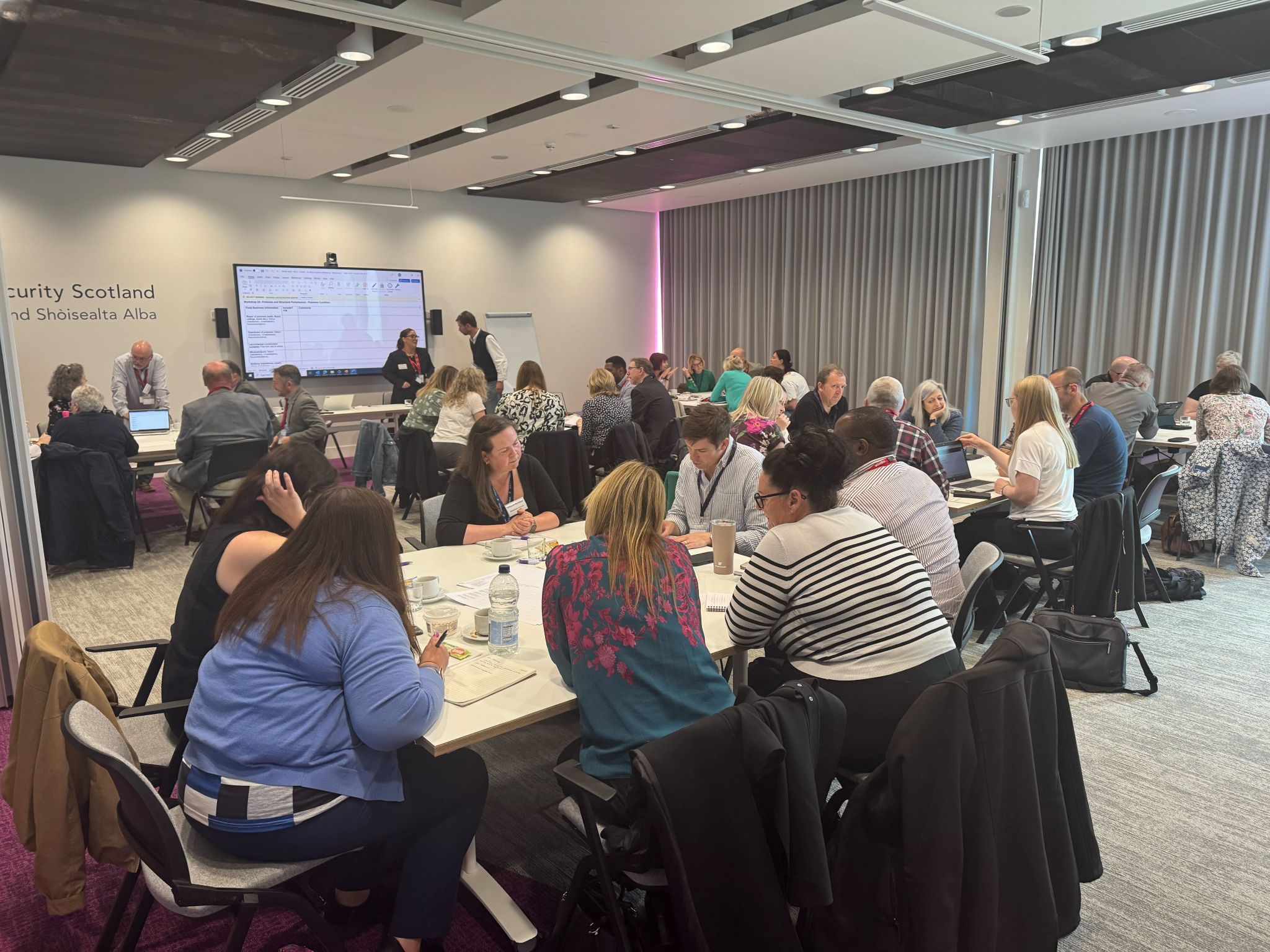
We brought all 32 Scottish local authorities into the same room to hear that directly, and tagged along with them in the field. They are just as frustrated as the citizens and businesses using the systems, which should not have surprised us but did a little. We observed enforcement officers doing inspections from printed spreadsheets, case workers re-entering data they had already collected somewhere else, and licensing managers trying to maintain a live picture of who is operating legally within their area from records spread across three separate systems. Those conversations shaped how we build.
Technology designed for the office and not for those in the field is the reason so much of this infrastructure has failed to land. You can build the most elegant system in the world and it will not survive contact with a licensing officer who has eleven years of workarounds and a healthy scepticism about promises from software companies.
The consequences run in both directions. For the licensing officer, it is a system that creates work rather than removing it. For the business owner, it is a process that feels designed to slow them down rather than help them operate. For the citizen, it is slower decisions, less visibility, and no clear sense of where their application actually sits.
That is the experience the next generation of this infrastructure has to replace. Not just cleaner interfaces, but systems that guide businesses through what they need, keep citizens informed without them having to chase, and give enforcement officers the right information at the right moment in the field. All of it underpinned by policy and legislation applied consistently, automatically, and in a way that actually holds up legally. That shift from digital process to something closer to an intelligent, agentic experience is where this is heading, but it only works if the foundation underneath it is solid.
Why this time is different
For most of the last decade the conversation about digital government focused on the front end. Better portals, cleaner interfaces, single login. Each of those is worth doing, but none of them necessarily addresses the fragmentation underneath.
What is changing now is that AI and automation are making the broken foundations harder to ignore. You cannot build an intelligent system on top of unstructured, disconnected data, and you cannot automate a workflow that was never properly designed. The ambition around AI in government is, whether people have named it yet or not, a conversation about infrastructure, and that is what is shifting resources and attention toward the layer that actually needs fixing.
Scotland’s Digital Strategy explicitly names licensing and permitting as a leading candidate for common, shared digital services. Not an ambition statement. A procurement signal, and the clearest indication yet that the infrastructure question is moving from “someone should fix this” to “someone is going to be asked to.” What makes this strategy different from previous ones is that it comes with an execution plan, named sponsors, and live use cases already in delivery. We are in the privileged position of driving that forward alongside the Scottish Government, which means the work we are describing here is not theoretical. It is already happening.
What we are building toward
What we are working toward is not just a better portal for businesses and a less painful system for licensing teams, though it is both of those things.
A world where a business owner in Aberdeen or Penzance does not have to piece together which licences apply to them, track down which body issues each one, and navigate every process from scratch. Where a licensing officer spends their time on the work that actually requires their judgement, not on data entry that a machine should handle. Where a citizen never has to fill in a form again. Where data shared between enforcement agencies means a problem flagged in one area does not stay invisible in the next.
None of that is science fiction, and all of it depends on the foundation being right.
Building plumbing is unglamorous work. It does not get announced at conferences and nobody puts it in a press release. But when it works, everything built on top of it works too, and when it does not, no amount of interface redesign will fix what is broken underneath.
That is the work. We are rolling up our sleeves and getting on with it.

Written by James Buchan, CEO, ePass
ePass is building the shared infrastructure for licensing, registration and permitting across the UK. If you work in local or central government, regulation or interested in public sector digital reform, I’d love would like to talk – Connect on LinkedIn